
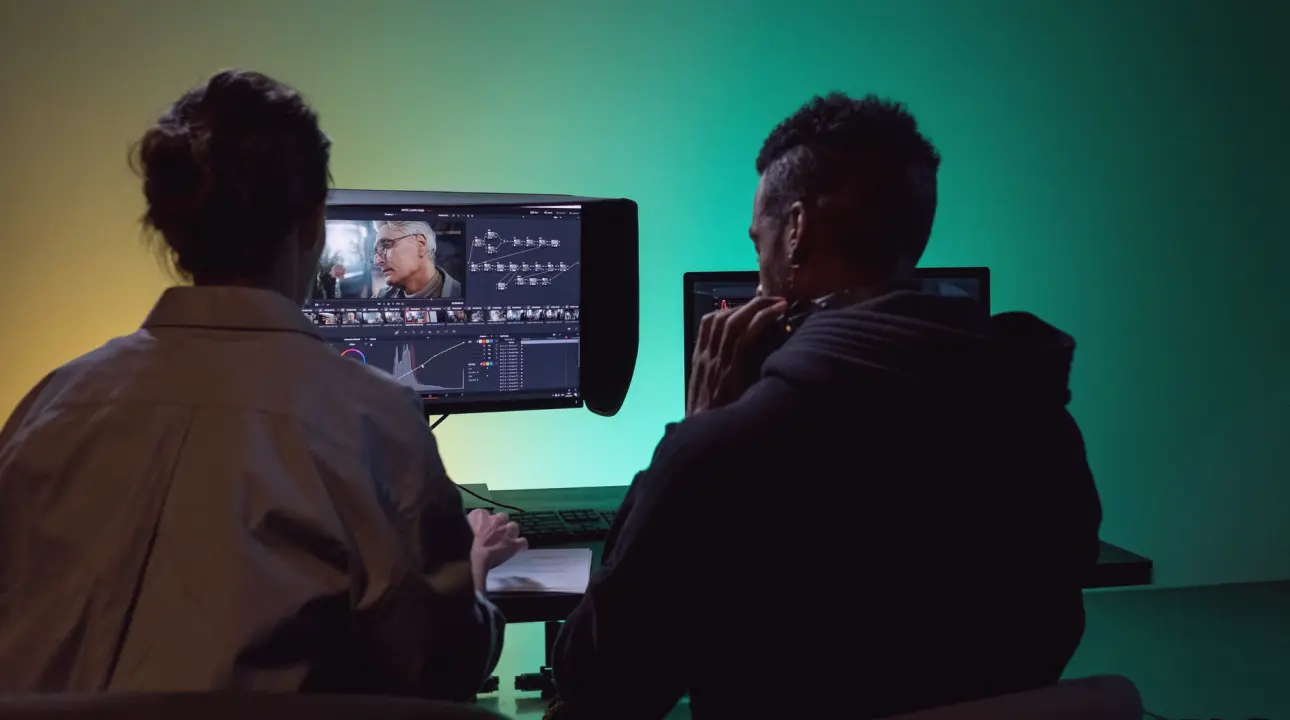
How a training day is laid out
Our operator training is built around a working desk rather than a classroom. A session starts with a short walk through the signal path of the room we are using: where each camera enters, how it reaches the switcher, where graphics and replay join, and how the finished programme leaves the building. Trainees trace one source at a time with a finger on the cable or the patch label, then confirm it on the monitor wall.
Only after that do we ask anyone to touch the switcher. The first hour is deliberately slow, because people who understand where a picture comes from make better decisions when something goes wrong. We keep groups small so that every trainee spends real time on the desk instead of watching someone else cut.
Callum, who writes this note, runs the signal-flow portion of each session, and Priya Sandhu leads the timing and calling exercises that follow. Between them the day moves from how things connect to how they behave under a running clock.
- Signal path walk-through before any switching
- Small groups so everyone gets desk time
- Signal flow first, timing second
Learning to read the signal path
Most live problems are routing problems in disguise. A black frame, a missing return feed or a graphic that will not key usually comes down to one wrong crosspoint or one unterminated connection. We teach trainees to ask a fixed set of questions in a fixed order: is the source present, is it routed, is it selected, is it visible on the output.
To make this stick we set up small faults on purpose in a rehearsal environment and ask the trainee to find them while the rest of the group watches the monitors. The point is not to catch anyone out. It is to build a habit of checking calmly from the source forward instead of pressing buttons at random.
By the end of this block, trainees can draw the signal path of their own control room from memory. That drawing becomes a reference they can pin up beside their desk and hand to colleagues who join the team later.
- Four questions asked in the same order every time
- Rehearsed faults that teach fault-finding
- A hand-drawn signal map to take back to your own room
Switching with a running show
Once the routing makes sense, trainees cut a real multi-camera rundown. We start with a simple two-camera conversation and add sources one at a time: a wide, a close-up, a graphic, a pre-recorded insert. Each addition brings a new thing to listen for on the intercom and a new moment where timing matters.
Priya coaches on how to anticipate rather than react. A good cut usually happens because the operator heard the director a beat early and had the next source ready, not because they were quick with the button. We practise taking calls, repeating them back and acknowledging changes without talking over the director.
Mistakes are part of the exercise and are discussed afterwards in plain terms. A late cut is a useful thing to replay, because the group can see exactly where the call and the action drifted apart.
- Rundown built up one source at a time
- Calls repeated back so nothing is misheard
- Replay of mistakes reviewed without blame
Show discipline and intercom habits
Discipline on a live show is mostly a matter of small habits. Keep the intercom clear while the director is calling. Say what you are doing in short, agreed phrases. Do not fix something silently if the fix changes the picture. We rehearse these habits until they feel ordinary, because on air there is no time to remember them.
We also spend time on what happens in the quiet moments: the countdown to going live, the break, the handover after a fault. These are the points where teams tend to relax or to panic, and a short, steady routine keeps everyone aligned.
Trainees leave with a one-page checklist for pre-show, in-show and post-show tasks, written in our own words and adjustable for their room. Teams that adopt it tend to find their rehearsals shorter, because fewer basic questions are left for the last minute.
- Short agreed phrases on the intercom
- Routines for countdown, breaks and handovers
- One-page checklist adapted to your own room
Training in your room or ours
We can run sessions at our base in Brighton or in your own control room, which is often the better option. Training on the equipment your team will actually use removes the gap between what was learned and what is on the desk on Monday morning. When we visit, we spend the first part of the day checking labels, monitor layout and intercom channels as they stand.
If your room has quirks, we work with them rather than around them. A confusing patch bay or an awkward monitor position is a legitimate subject for a training session, and sometimes the most useful advice we give is a small change to the room.
Group size, length and focus are agreed beforehand through the contact page, and the price depends on those choices. The prices page sets out how enquiries, written quotations and invoices work, so there are no surprises on either side.
- Sessions in Brighton or at your premises
- Room layout and labelling checked on arrival
- Scope agreed in writing before the day
What teams take away afterwards
The aim of training is a team that can run its own show without us standing behind them. By the end, operators should be able to explain the signal path, cut a rundown cleanly, communicate on the intercom and recover from a basic fault without waiting for help.
We usually suggest a short follow-up call a few weeks later, once the team has run real shows. That conversation is often where the most practical advice emerges, because people now know which parts of the desk still feel unfamiliar and which habits have taken hold.
Some clients return for a second session focused on one topic, such as replay or remote feeds. Others simply keep the checklist and the signal map and carry on. Both outcomes are fine, as long as the team feels steadier at the desk than when we started.
- Operators who can explain their own signal path
- Optional follow-up call after real shows
- Second sessions on a single topic if needed
Training works when it is practical, unhurried and tied to the room people really work in. Our sessions give in-house teams a clear picture of signal flow, a steady hand at the switcher and habits they can rely on when the show is live. If your team is growing or changing, get in touch through the contact page and we will talk through what a session could cover.